
29 January 2011

Virginia Astley - Promise Nothing

Promise Nothing

There are some artists who have had a significant presence in pop while staying very much in the shadows. One of these would be Virginia Astley, whose discography is (mostly) unavailable and in any case entirely obscure to most followers of pop.

Born to Edwin (Ted) Astley in 1959, he of "The Saint" and "Danger Man" themes, Virginia found herself in a musical family. Her elder sister Karen married Pete Townshend and her brother Jon was a noted producer and mastering engineer. Taking up piano and then flute, Virginia's initial recorded output was as keyboard player with Victims Of Pleasure, who released three singles between 1980 and 1982. During this same period she accompanied Richard Jobson's poetry on The Ballad Of Etiquette and sang on "La Chanson D'Helene" by The Dream Makers, included on the impressive Le Disque du Crépuscule compilation From Brussels With Love.

There was little here to suggest that Virginia Astley was soon to release some of the loveliest pop of the era. In fact I missed the release of the 10" EP A Bao A Qu in the first month of 1982 and was equally unaware of the single "Love's A Lonely Place To Be" exactly one year later. But, living in Canada, I was lucky enough to latch onto the compilation Promise Nothing when it was issued. The exclusive Canadian version of this lost album used the artwork from "Love's A Lonely Place To Be". Two versions issued in Belgium on Les Disques Du Crépuscule (in 1983 and 1985) have different, and to my mind completely inappropriate, cover art.

What we have here are the four tracks from A Bao A Qu on the first side, and the four from the 12" of "Love's A Lonely Place To Be" on the flip. One track, "Soaring", has been remixed. The last two selections are instrumentals most properly heard on her second album, here used to fill space -- though in the nicest possible way.

The result is an extraordinary melding of Virginia's girl-next-door soprano, chamber orchestra arrangements and bitter-sweet lyrics about the death of love. Her brother Jon's production is exemplary, with arrangements that could not be bettered. But it passed through the listening public like a ghost, some five years before its time (if I compare it to the success of Enya's Watermark).
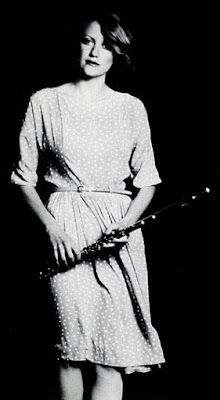
Virginia AstleyThis debut was followed by From Gardens Where We Feel Secure, a lyric-free recreation of Hertfordshire ambiance, divided suggestively into Morning and Afternoon sides. Released through Rough Trade in July 1983, this is the only Astley album (out of an eventual five) to remain in print. Incidentally, it marks another Skids connection, being produced by Russell Webb. His sensitivity to the delicate and subtly evolving music is evident. The melding of instruments with location recordings creates an evocative aural space. If you like Promise Nothing, you owe it to yourself (and the artist) to buy a copy of this CD!

Virginia was to go on to have a taste of popular success. Signing to Elektra she released Hope In A Darkened Heart in 1986, performing a duet with David Sylvian on the lead-off single "Some Small Hope". This was enough to get the album released throughout Europe and even in the USA. While I dislike Ryuichi Sakamoto's overly slick production and don't think much of the single, the album has much to recommend it.

The Astley catalogue is currently in disarray. Hope In A Darkened Heart has been recently reissued in Japan without permission. Other master tapes are lost. Astley herself is not fond of Promise Nothing. Will we ever see a comprehensive re-issue of her catalogue?

Visit her excellent website for detailed discography information.

-- The Second Chameleon

download
Promise Nothing

A1 We Will Meet Them Again (4:00)
A2 Arctic Death (3:02)
A3 Angel Crying (3:46)
A4 Sanctus (2:08)
B1 Love's A Lonely Place To Be (3:27)
B2 Soaring (3:25)
B3 Futility (3:25)
B4 A Summer Long Since Passed (4:40)
B5 It's To Hot To Sleep (5:40)

LP Canada: Why Fi Records / Sire [WYFI 14] 1983 [cover from "Love's A Lonely Place To Be"]

LP Belgium: Les Disques Du Crépuscule [TWI 194] 1983 [cover by Catherine Lazure]

LP Belgium: Les Disques Du Crépuscule [TWI 194] 1985 [cover by Joël Van Audenhaege]


We have done a special mastering job on Promise Nothing, replacing three of the tracks with superior CD rips and using spectral analysis to clean out clicks and pops. Unfortunately there is some distortion that simply could not be removed without significantly damaging the music, but it shouldn't be too noticeable.

P.S. We are experimenting with offering alternatives to Rapidshare. If you like, you can download from Mediafire by clicking on the appropriate icon above.

11 January 2011

The Human League - The Dare! Demos


It remains one of the great mysteries of the age. Like who built the pyramids, or what was the purpose of Stonehenge. How did Phil Oakey come up with Dare!, one of the defining statements of eighties synthpop?

The odds were certainly against him. When the League Mark I split, Ian Craig Marsh and Martyn Ware took all the song writing and production skills with them. Oakey was left only with Adrian Wright, the guy who did the slide projections for their live shows, and his trademark hair cut. Neither Oakey nor Wright had any real experience playing an instrument, let alone knew much about writing a hit single. And Oakey's first move was hardly one to inspire any confidence: rather than hire some musicians to play the backing parts for a European tour that had been booked before the split, he recruited a couple of school girls he had spotted at the local disco to be dancers for the band.

So where did Dare! come from? Well, the simple answer, and the one most commonly advanced, is: Martin Rushent. Having cut his teeth producing first-wave punk and post-punk acts like The Buzzcocks, Generation X, and XTC, he had spent the better of a quarter million pounds setting up Genetic Sound Studio, the centre piece of which was a Linn Drum machine. Where earlier drum machines could only play a fixed number of preset rhythm patterns, typically associated with rather dated dance styles like the Cha Cha or Bossa Nova, the Linn could be programmed to play anything the programmer liked. What was more, the Linn could be synchronized with arpeggiators and sequencers, allowing each part to sound perfectly in time with every other part. Rushent's mastery of the Linn drum machine, together with an innovative production style that isolated each instrument, affording each its own precise place in the acoustic field, gave the album its air of sleek, cool modernism.

The other answer looks past Rushent's studio skills to credit Ian Burden and, especially, Jo Callis, the hired guns that Oakey belatedly brought on board to help work out the musical backing to his and Wright's early song sketches. What this two cd set shows, however, is that neither answer fully suffices. The demos present here show that even at a very early stage in the album's development, and certainly well before Rushent was to add his distinctive touches, Oakey and Wright had begun to forge a very different conception of the band's sound. Where the songs for Reproduction and Travelogue were audio collages, built up from tracks painstakingly pieced together from individual modular synth patches, the songs for Dare! began with simple chords, mostly picked out on on the new generation of cheap polyphonic synthesizers (such as the Casio M10), and plaintive one-finger melodies that express an aching romanticism that was new to their sound. The League Mark II wrote songs, in short, with memorable lead lines and a distinctive tone--the very limitations of their abilities seem to have kept them from becoming overly predictable or formulaic.

The story of how Oakey and Wright, together with Callis, Burden, and the school girl dancers, Joanne Catherall and Susanne Sulley, developed these songs from the most rudimentary sketches to dance floor classics that still inspire shrieks of recognition whenever they're played, is presented in wonderful archaeological detail in this two cd set. There's plenty to intrigue the dedicated League fan who doesn't already have this set: alternate lyrics to "The Things That Dreams Are Made Of," early versions of "Do or Die" and "Open Your Heart" (here titled "Letting It Show" and "Banjo Song," respectively), and songs that didn't make the album, such as "In The Park" (a variation on Lou Reed's "Perfect Day" I suspect), and "Boxing on TV." But to my mind, the real answer to the question with which we began can be found at the very end of the second set, a methodically worked out bass line for the Ike and Tina Turner classic, "River Deep, Mountain High." The League Mark I was keen on on sixties r'n b standards, and even included "You've Lost That Loving Feeling" on their first album. Clearly at some point there must must have been some thought of doing something similar for Dare!

In the end, however, there would be no Phil Spector covers on Dare! Instead of RDMH, they included the haunting, austere, vaguely sinister theme from the film "Get Carter." That choice, and I suspect it was Oakey's choice, speaks volumes about how clearly the vocalist understood what he wanted from this album: romantic but danceable, glamorous but minimal, modern but nostalgic. If the success of Dare! belongs to any one, my money's on the guy with the lopsided hair cut.

-- Crash the Driver

The two cd set posted here is identical to that which was posted over at Going Underground, the links for which have now been dead for some time. We're posting it here following repeated requests from the members of the Blind Youth list, the place to go for all things related to the League Mark I. Our thanks to Going Underground for making it available.

The Dare! Demos CD One

The Dare! Demos CD Two

07 January 2011

Mick Karn RIP -- Sensitive

"Dead at age 52, of systematic cancer, Antony Michaelides of Nicosia, Cyprus, lately residing London."

This might be any announcement in the obituary columns for 4 January 2011, where it not that this was the alter ego of Mick Karn, a musician everyone reading this site has heard and loved, knowingly or not.

Self-taught to a high degree of accomplishment first on the bassoon, Karn rose to prominence as the bassist with Roxy Music disciples Japan. Treading shaky stylistic ground from their 1974 beginnings through to their glam debut Adolescent Sex (1978), this group of increasingly adept musicians transitioned by way of the Eurodisco-influenced Quiet Life (1979) to Gentlemen Take Polaroids (1980) in short order. Listen to the title track launch of this assured album and hear Karn (already) at full maturity, fretless bass sensuously throbbing and imperiously questing above the other instruments. It formed rhythm, melody and counter-melody in one. We'd heard nothing like it before.

Where the bass disappears it's only because Karn has taken to the saxophone. "Burning Bridges" is the spiritual descendent of Bowie's Berlin trilogy instrumentals -- in some ways Japan just wanted to keep rewriting "Art Decade" -- but, unlike all the other copyists, it's just as good. When Japan broke up after the resplendent Tin Drum (November 1981), Karn was the first of the group to release solo material in the form of the album Titles, available just a few months later. He had so many ideas, so much music in him, always trying to find that bridge between Motown funk and Turkish mystique.

Cursed with a cover fit to hex an entire career, Titles was a masterful demonstration of this synthesis. Perversely the a-side contained only instrumentals, leaving it to the flip to launch the catchy arrangement of "Saviour, Are You With Me?" Here Mick was showcased as lead singer for the first time on record, though he'd shared this task with David Sylvian in the early days of Japan. But that's not all. A complete listing of his credits here includes saxophone, ocarina, bassoon, clarinet, recorder, African flute, Mellotron, percussion, bongos, and computer & keyboard programming. Not to mention album production and mixing, a task he now shared but would later take on completely.

The album continues with "Trust Me" and "Sensitive," two more first-rate tracks. I swear that if the vinyl sides had been flipped, a photo of Mick in designated designer wear and make-up substituted for the ugly illustration and a video made for the single, this could have been the hit follow-up to Tin Drum. Instead Karn's solo career was shafted until 1987's lumbering Dreams Of Reason Produce Monsters and dalliances in the world of jazz-fusion (Bestial Cluster).

But in the meantime he paid the bills with a laundry list of excellent collaborative ventures and guest slots, starting with bass and sax on four tracks for Gary Numan's Dance album (1981), including single "She's Got Claws". Following the Japanese connection, Karn was all over Masami Tsuchiya's solo venture Rice Music (1982), returning for two tracks on Horizon (1988).

In 1983 his distinctive bass flavoured "Glow World" on Bill Nelson's Chimera (1983), a track later packaged into Vistamix (1984) and making best-of compilations like Duplex (1989). Elsewhere on Chimera Nelson himself channels Karn -- just listen to "Everyday Feels Like Another New Drug".

Karn managed one moment in the charts, paired with Midge Ure for the "After A Fashion" single (1983), returning for "Remembrance Day" on the Ure LP Answers To Nothing (1988). (In his final year on earth, Karn was assisted by Ure in fund-raising mode, in an effort that moved the artist back to London from Cyprus for the expensive medical treatments he needed. But which alas came too late. "Another New Drug" indeed.)

Of all such pairings, the highest profile was Dalis Car (sic), a venture with Peter Murphy that was to prove worthy of one album and accompanying single. Too strange by half, The Waking Hour (1984) is essential listening. Falling out over ego in an echo of the Karn-Sylvian feud, it took until 2010 for Murphy to state he was going to rejuvenate the project -- too late by half.

Mark Isham, Lonely Universe, Kate Bush, Joan Armatrading, Kim Wilde... the guest appearances continued apace through the nineties, including some with former band-members Steve Jansen And Richard Barbieri. Stories Across Borders (1991) presaged the Japan line-up reuniting for the one-off Rain Tree Crow album, the result far better than it had any right to be, maybe because the sessions were kept loose and improvisational. But perhaps more important for Karn's own development was his collaboration on David Torn's Door X (1992). Torn was to become a full musical partner on releases under Karn's own name, alongside monikers like "David Torn / Mick Karn / Terry Bozzio", issued in a steady stream by Germany's CMP label.

Fans will excuse me for finding little enough of this output vital, even if it continued the admirably free-wheeling imagination of a questing artist. An accomplished sculptor, trained psychotherapist and much more besides, Mick Karn was a Renaissance Man in a world that prefers easy pigeon-holing. Judging by his releases in the last decade he was not standing still. Check out Three Part Species from 2006. Though bass takes a back seat, Mick's production of this fractured music is excellent.

We honour the premature passing of this fine artist by returning to his very first solo offering, never since made available. Our own vinyl rip of "Sensitive" includes the mix that differs from that used on the 12" vinyl and album. The b-side is also a shorter earlier version of what was to appear on Titles (the 12" single version is different again).

Imagine if in some bright alternative universe this Fin Costello photo had graced the album itself. Mick Karn, superstar? He came so close.

-- The Second Chameleon

download
Sensitive

A Sensitive [7" single mix] (3:55)
B The Sound Of Waves [7" single mix] (3:42)
7" UK: Virgin [VS 508] 1982


For more, search YouTube for the music video for "The Judgment Is The Mirror" and Dalis Car's appearance on The Old Grey Whistle Test, performing "His Box." There you'll also find "After a Fashion" with Midge Ure, "She's Got Claws" with Gary Numan, "Wedding List" (live) with Kate Bush (featuring Pete Townsend, Phil Collins, Midge Ure and a famous wardrobe malfunction), plus a strange pairing with Angie Bowie -- reciting poetry.

Mick Karn's autobiography, Japan And Self Existence, is available on Lulu. Innerviews has a fine interview. Finally, visit the dedicated Mick Karn website, sometimes overloaded these days. They have free downloads from Karn's later work for you to sample.

11 November 2010

Messengers - Complete Singles


Messengers should have had it all. They had the gear, the talent, and the songs. They were a synth pop duo at the very height of the music-buying public's fascination with guys in buttoned-up shirts and monophonic synthesizers. And they had the unstinting support of the prime mover of all things New Romantic, Midge Ure. Ure signed them to his label, produced their records, and even invited them to tour the world with Ultravox. But not everything works out as it should.

Messengers were formed out of the ashes of Modern Man, a Glaswegian post-punk outfit that Ure discovered playing in a bar on Sauchiehall Street. Ure took an instant liking to the band, and offered to produce their first and only lp, Concrete Scheme (1980). Though it featured some strong songs (Ure would later cover "Wastelands" on his solo debut), the band broke up soon after its release. Drummer Colin King and guitarist Danny Mitchell decided to carry on as a duo, with King taking on the lead vocal duties and Mitchell turning his attention to the synthesizer. Calling themselves The Furious Monkeys, they recorded some demos on a four track tape deck and sent them to their former mentor.

More than a year passed when, out of the blue, Ure asked them if they'd like to support Ultravox on their upcoming Monument tour. Ure also suggested that they should have something to hock while they were getting the chance to play in front of such large audiences. Mitchell and King happily agreed: they signed with Ure's Musicfest label, a subsidiary of Chrysalis, and set about recording their first single. The Furious Monkeys had suddenly become Messengers.

"I Turn In (To You)" (1982) has the full and lush sound that Ure and his compatriots had been developing on albums such as Quartet (1981), and on Ure's own solo single from the period, "No Regrets" (1982). In a recent interview, Mitchell suggests that the similarity was the result of circumstances rather than any effort to consciously emulate Ure:

"I think the similarity of the sounds would be down to sound engineer extraordinaire John Hudson who was Midge’s first choice in those days and Warren Cann’s Linndrum and, of course, Midge’s guiding hand. The other ingredients were a heavily compressed vintage Steinway, a trusty Yamaha string machine and my duophonic Yamaha synth. As for the vocals, they were painstakingly put together almost word by word, much to Colin’s frustration, in a technique that Midge favoured."

"I Turn In (To You)" may indeed sound rather like paint-by-numbers Ultravox, but, to its credit, it is a much more successful attempt to recreate that sound than many bands were able to manage during this period. The vocals, in particular, have that Olympian quality of yearning that few singers can achieve convincingly. And it has a positively sublime middle eight.

Messengers toured the world with Ultravox, taking their place on a towering gantry to the left of the impressive, monochromatic stage set each night. Mitchell added additional keyboard parts, while both he and King sang backing vocals, allowing the band to reproduce the increasingly dense wall of sound that Ultravox had become known for on their albums. On one occasion, while playing in France, King accidentally toppled from their crow's nest and broke his arm. Mitchell picks up the story:

"At the end of the show Midge called out, whilst turning to face our perch, ‘Our special guests Messengers’. With a combined look of confusion, puzzlement and anger he mouthed to me, ‘Where the f**k is Colin?’ Meanwhile, Colin was having his wedding ring surgically removed by bemused French medical staff, who, due to language difficulties, had concluded that he had fallen from a trapeze."

The duo's contribution to Ultravox's live sound during this period is abundantly evident on Monument (1982), the audio record of this tour, and one which has been recently remastered and expanded.

Messengers went on to release two more singles, both produced by Ure. "Great Institutions" (1983) featured a gorgeous Bronzino nude on its Peter Saville-designed cover, and a pair of impressive b sides, including a live track, "Strawboy." "Frontiers" (1984) added a wash of feedback guitar as texture and showed the duo continuing to grow as song writers and arrangers. The b sides offered a tip of the hat to Bowie's influence with a cover of "Andy Warhol."

And that was that. Though the band had enough material for an album, and Ure continued to stand by his Glaswegian mates, Chrysalis wasn't willing to put the money up to record a long player and the duo went their separate ways. Mitchell continued his collaboration with Ure, co-writing one of his best-known singles, "If I Was," but there was little else to be said of Messengers until 2004 when King and Mitchell reunited to record the songs that they had imagined forming their first long player all those years ago, and then releasing it directly through Extreme Voice, the Ultravox fan site. You can purchase a copy here.

Messengers have been unfairly overlooked, even in this remaster and reissue age of ours. Despite their close association with one of the best-known bands of the eighties, there's no Wikipedia page, and the entries at All Music Guide and Discogs are threadbare at best. Listened back to back, however, the three singles and the accompanying b sides gathered here make a persuasive case for the duo's claim to being something more than a footnote in the Ultravox story.

--Crash the Driver

download


"I Turn In (To You)"

01 I Turn In (To You)
02 The Semi-Professionals (Theme One)

UK 7" Chrysalis [CHS 2663] 1982

"Great Institutions"

03 Great Institutions (MF Mix)
04 Here Come The Heroes
05 Strawboys (Live)

UK 12" Chrysalis [MUST X1] 1983

"Frontiers"

06 Frontiers (Extended Version)
07 The Plains of Siberia
08 Andy Warhol

UK 12" Chrysalis [MUST X2] 1984

30 September 2010

The Fallout Club - Complete Singles


It would be easy to assume that The Fallout Club was Thomas Dolby's band, the answer to the question, what was the "She Blinded Me With Science" guy doing before he embarked on a solo career? This is certainly how the band is best remembered, but The Fallout Club began as Trevior Herion's effort to break into synth pop.

TSM has already blogged about Herion's early career here. Following a spell with power pop combo The Civilians, Herion and drummer Paul Simon formed The Fallout Club as a duo, securing a one-off release through Secret Records, the label that had released The Civilians' first release. "Falling Years" b/w "The Beat Boys" cast a restrained Herion vocal against a cracking, drum machine-like backbeat and little else, save the faintest hint of a bass line. Stark and minimal, the effect owes a notable debt to The Normal's groundbreaking "Warm Leatherette" and "T.V.O.D.," but fails to make suitable use of Herion's greatest asset, his talent for gorgeous melodies.

That would change the following year, as Herion and Simon hooked up with Dolby and Matthew Seligman. The keyboardist and guitarist were on the run from Bruce Wooley and the Camera Club, Wooley's failed effort to capitalize on his writing credit for The Buggle's "Video Killed The Radio Star," a breakout hit in 1979. Herion and Dolby were a match made in heaven. Dolby brought not only his battery of synthesizers, but his burgeoning talent for lush, dramatic arrangements, and Herion dug down deep and found a voice to match, towering and romantic. They cut a deal with fledgling indie label Happy Birthday Records, and released the second Fallout Club single in May, 1981.

"Dream Soldiers" b/w "Pedestrian Walkway" is one of the most perfect synth pop singles of the period. The b-side was a Dolby composition, the repeated refrain of the title offering a cheeky variation on the New Romantic affinity with vehicular traffic scenes, from underpasses to autobahns. It was sharp and clever, a clear indication of the the playful but somehow still heartfelt songs to come on The Golden Age of Wireless. The a-side, one of Herion's own compositions, was a more serious affair, a swirling, pulsing, synth ballad, with the vocalist's plaintive cries rising up over the keyboardist's fluttering arpeggiators, drawing favourable comparisons with the dreamier, darker moments of OMD, Numan, or John Foxx.

The best was yet to come, however. "Wonderlust" b/w "Desert Song" was released five months later, in October of 1981. A clear step forward from "Pedestrian Walkway," the Dolby-penned a-side opens with a bold, "Bolero"-like trumpet before the synths and drum machines come shuddering to the fore, Herion's mighty vocals trading off with Dolby's theremin-like counterpoint, and the verses building to one of the most achingly poignant choruses in synth pop. And the b-side, written by Herion, was scarcely less impressive, with a grand T.E. Lawrence vibe summoning up images of riders sweeping across the desert dunes. Dolby adds the muscular backing vocals, while Simon and Seligman get to showcase their skills on drums and lead guitar. The single may not have disturbed the charts, but in retrospect it is one of the great achievements of the period.

By late 1981, however, Dolby's evident talents were starting to take him away from his collaboration with Herion. Lene Lovich asked him to write and produce her next single, the brilliant "New Toy." And then top forty hit machine Foreigner asked him to sprinkle some of his fairy dust on their IV album. A solo career beckoned, and Herion too thought it was time to strike out on his own, but one cannot help but wonder what might have been had they stuck it out as The Fallout Club. An album's worth of tracks like "Wonderlust" would have been very welcome indeed.

Gathered here are all three Fallout Club singles, newly ripped from our own vinyl copies. As a bonus we've included the instrumental version of "Kiss of No Return," the b-side of Herion's debut solo single, and his last collaboration with Dolby, who arranged the track.

--Crash the Driver

download


"Falling Years"

01 Falling Years
02 The Beat Boys

UK 7" Secret [SSH 104] 1980

"Dream Soldiers"

03 Dream Soldiers
04 Pedestrian Walkaway

UK 7" Happy Birthday [UR 3] 1981

"Wonderlust"

05 Desert Song
06 Wonderlust

UK 12" Happy Birthday [UR 127] 1981

"Kiss of No Return"

07 Kiss of No Return (Instrumental)

UK 7" Imperial [MPE 1] 1982