07 January 2011

Mick Karn RIP -- Sensitive

"Dead at age 52, of systematic cancer, Antony Michaelides of Nicosia, Cyprus, lately residing London."

This might be any announcement in the obituary columns for 4 January 2011, where it not that this was the alter ego of Mick Karn, a musician everyone reading this site has heard and loved, knowingly or not.

Self-taught to a high degree of accomplishment first on the bassoon, Karn rose to prominence as the bassist with Roxy Music disciples Japan. Treading shaky stylistic ground from their 1974 beginnings through to their glam debut Adolescent Sex (1978), this group of increasingly adept musicians transitioned by way of the Eurodisco-influenced Quiet Life (1979) to Gentlemen Take Polaroids (1980) in short order. Listen to the title track launch of this assured album and hear Karn (already) at full maturity, fretless bass sensuously throbbing and imperiously questing above the other instruments. It formed rhythm, melody and counter-melody in one. We'd heard nothing like it before.

Where the bass disappears it's only because Karn has taken to the saxophone. "Burning Bridges" is the spiritual descendent of Bowie's Berlin trilogy instrumentals -- in some ways Japan just wanted to keep rewriting "Art Decade" -- but, unlike all the other copyists, it's just as good. When Japan broke up after the resplendent Tin Drum (November 1981), Karn was the first of the group to release solo material in the form of the album Titles, available just a few months later. He had so many ideas, so much music in him, always trying to find that bridge between Motown funk and Turkish mystique.

Cursed with a cover fit to hex an entire career, Titles was a masterful demonstration of this synthesis. Perversely the a-side contained only instrumentals, leaving it to the flip to launch the catchy arrangement of "Saviour, Are You With Me?" Here Mick was showcased as lead singer for the first time on record, though he'd shared this task with David Sylvian in the early days of Japan. But that's not all. A complete listing of his credits here includes saxophone, ocarina, bassoon, clarinet, recorder, African flute, Mellotron, percussion, bongos, and computer & keyboard programming. Not to mention album production and mixing, a task he now shared but would later take on completely.

The album continues with "Trust Me" and "Sensitive," two more first-rate tracks. I swear that if the vinyl sides had been flipped, a photo of Mick in designated designer wear and make-up substituted for the ugly illustration and a video made for the single, this could have been the hit follow-up to Tin Drum. Instead Karn's solo career was shafted until 1987's lumbering Dreams Of Reason Produce Monsters and dalliances in the world of jazz-fusion (Bestial Cluster).

But in the meantime he paid the bills with a laundry list of excellent collaborative ventures and guest slots, starting with bass and sax on four tracks for Gary Numan's Dance album (1981), including single "She's Got Claws". Following the Japanese connection, Karn was all over Masami Tsuchiya's solo venture Rice Music (1982), returning for two tracks on Horizon (1988).

In 1983 his distinctive bass flavoured "Glow World" on Bill Nelson's Chimera (1983), a track later packaged into Vistamix (1984) and making best-of compilations like Duplex (1989). Elsewhere on Chimera Nelson himself channels Karn -- just listen to "Everyday Feels Like Another New Drug".

Karn managed one moment in the charts, paired with Midge Ure for the "After A Fashion" single (1983), returning for "Remembrance Day" on the Ure LP Answers To Nothing (1988). (In his final year on earth, Karn was assisted by Ure in fund-raising mode, in an effort that moved the artist back to London from Cyprus for the expensive medical treatments he needed. But which alas came too late. "Another New Drug" indeed.)

Of all such pairings, the highest profile was Dalis Car (sic), a venture with Peter Murphy that was to prove worthy of one album and accompanying single. Too strange by half, The Waking Hour (1984) is essential listening. Falling out over ego in an echo of the Karn-Sylvian feud, it took until 2010 for Murphy to state he was going to rejuvenate the project -- too late by half.

Mark Isham, Lonely Universe, Kate Bush, Joan Armatrading, Kim Wilde... the guest appearances continued apace through the nineties, including some with former band-members Steve Jansen And Richard Barbieri. Stories Across Borders (1991) presaged the Japan line-up reuniting for the one-off Rain Tree Crow album, the result far better than it had any right to be, maybe because the sessions were kept loose and improvisational. But perhaps more important for Karn's own development was his collaboration on David Torn's Door X (1992). Torn was to become a full musical partner on releases under Karn's own name, alongside monikers like "David Torn / Mick Karn / Terry Bozzio", issued in a steady stream by Germany's CMP label.

Fans will excuse me for finding little enough of this output vital, even if it continued the admirably free-wheeling imagination of a questing artist. An accomplished sculptor, trained psychotherapist and much more besides, Mick Karn was a Renaissance Man in a world that prefers easy pigeon-holing. Judging by his releases in the last decade he was not standing still. Check out Three Part Species from 2006. Though bass takes a back seat, Mick's production of this fractured music is excellent.

We honour the premature passing of this fine artist by returning to his very first solo offering, never since made available. Our own vinyl rip of "Sensitive" includes the mix that differs from that used on the 12" vinyl and album. The b-side is also a shorter earlier version of what was to appear on Titles (the 12" single version is different again).

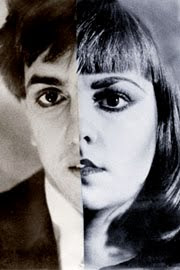
Imagine if in some bright alternative universe this Fin Costello photo had graced the album itself. Mick Karn, superstar? He came so close.

-- The Second Chameleon

download
Sensitive

A Sensitive [7" single mix] (3:55)
B The Sound Of Waves [7" single mix] (3:42)
7" UK: Virgin [VS 508] 1982


For more, search YouTube for the music video for "The Judgment Is The Mirror" and Dalis Car's appearance on The Old Grey Whistle Test, performing "His Box." There you'll also find "After a Fashion" with Midge Ure, "She's Got Claws" with Gary Numan, "Wedding List" (live) with Kate Bush (featuring Pete Townsend, Phil Collins, Midge Ure and a famous wardrobe malfunction), plus a strange pairing with Angie Bowie -- reciting poetry.

Mick Karn's autobiography, Japan And Self Existence, is available on Lulu. Innerviews has a fine interview. Finally, visit the dedicated Mick Karn website, sometimes overloaded these days. They have free downloads from Karn's later work for you to sample.

11 November 2010

Messengers - Complete Singles


Messengers should have had it all. They had the gear, the talent, and the songs. They were a synth pop duo at the very height of the music-buying public's fascination with guys in buttoned-up shirts and monophonic synthesizers. And they had the unstinting support of the prime mover of all things New Romantic, Midge Ure. Ure signed them to his label, produced their records, and even invited them to tour the world with Ultravox. But not everything works out as it should.

Messengers were formed out of the ashes of Modern Man, a Glaswegian post-punk outfit that Ure discovered playing in a bar on Sauchiehall Street. Ure took an instant liking to the band, and offered to produce their first and only lp, Concrete Scheme (1980). Though it featured some strong songs (Ure would later cover "Wastelands" on his solo debut), the band broke up soon after its release. Drummer Colin King and guitarist Danny Mitchell decided to carry on as a duo, with King taking on the lead vocal duties and Mitchell turning his attention to the synthesizer. Calling themselves The Furious Monkeys, they recorded some demos on a four track tape deck and sent them to their former mentor.

More than a year passed when, out of the blue, Ure asked them if they'd like to support Ultravox on their upcoming Monument tour. Ure also suggested that they should have something to hock while they were getting the chance to play in front of such large audiences. Mitchell and King happily agreed: they signed with Ure's Musicfest label, a subsidiary of Chrysalis, and set about recording their first single. The Furious Monkeys had suddenly become Messengers.

"I Turn In (To You)" (1982) has the full and lush sound that Ure and his compatriots had been developing on albums such as Quartet (1981), and on Ure's own solo single from the period, "No Regrets" (1982). In a recent interview, Mitchell suggests that the similarity was the result of circumstances rather than any effort to consciously emulate Ure:

"I think the similarity of the sounds would be down to sound engineer extraordinaire John Hudson who was Midge’s first choice in those days and Warren Cann’s Linndrum and, of course, Midge’s guiding hand. The other ingredients were a heavily compressed vintage Steinway, a trusty Yamaha string machine and my duophonic Yamaha synth. As for the vocals, they were painstakingly put together almost word by word, much to Colin’s frustration, in a technique that Midge favoured."

"I Turn In (To You)" may indeed sound rather like paint-by-numbers Ultravox, but, to its credit, it is a much more successful attempt to recreate that sound than many bands were able to manage during this period. The vocals, in particular, have that Olympian quality of yearning that few singers can achieve convincingly. And it has a positively sublime middle eight.

Messengers toured the world with Ultravox, taking their place on a towering gantry to the left of the impressive, monochromatic stage set each night. Mitchell added additional keyboard parts, while both he and King sang backing vocals, allowing the band to reproduce the increasingly dense wall of sound that Ultravox had become known for on their albums. On one occasion, while playing in France, King accidentally toppled from their crow's nest and broke his arm. Mitchell picks up the story:

"At the end of the show Midge called out, whilst turning to face our perch, ‘Our special guests Messengers’. With a combined look of confusion, puzzlement and anger he mouthed to me, ‘Where the f**k is Colin?’ Meanwhile, Colin was having his wedding ring surgically removed by bemused French medical staff, who, due to language difficulties, had concluded that he had fallen from a trapeze."

The duo's contribution to Ultravox's live sound during this period is abundantly evident on Monument (1982), the audio record of this tour, and one which has been recently remastered and expanded.

Messengers went on to release two more singles, both produced by Ure. "Great Institutions" (1983) featured a gorgeous Bronzino nude on its Peter Saville-designed cover, and a pair of impressive b sides, including a live track, "Strawboy." "Frontiers" (1984) added a wash of feedback guitar as texture and showed the duo continuing to grow as song writers and arrangers. The b sides offered a tip of the hat to Bowie's influence with a cover of "Andy Warhol."

And that was that. Though the band had enough material for an album, and Ure continued to stand by his Glaswegian mates, Chrysalis wasn't willing to put the money up to record a long player and the duo went their separate ways. Mitchell continued his collaboration with Ure, co-writing one of his best-known singles, "If I Was," but there was little else to be said of Messengers until 2004 when King and Mitchell reunited to record the songs that they had imagined forming their first long player all those years ago, and then releasing it directly through Extreme Voice, the Ultravox fan site. You can purchase a copy here.

Messengers have been unfairly overlooked, even in this remaster and reissue age of ours. Despite their close association with one of the best-known bands of the eighties, there's no Wikipedia page, and the entries at All Music Guide and Discogs are threadbare at best. Listened back to back, however, the three singles and the accompanying b sides gathered here make a persuasive case for the duo's claim to being something more than a footnote in the Ultravox story.

--Crash the Driver

download


"I Turn In (To You)"

01 I Turn In (To You)
02 The Semi-Professionals (Theme One)

UK 7" Chrysalis [CHS 2663] 1982

"Great Institutions"

03 Great Institutions (MF Mix)
04 Here Come The Heroes
05 Strawboys (Live)

UK 12" Chrysalis [MUST X1] 1983

"Frontiers"

06 Frontiers (Extended Version)
07 The Plains of Siberia
08 Andy Warhol

UK 12" Chrysalis [MUST X2] 1984

30 September 2010

The Fallout Club - Complete Singles


It would be easy to assume that The Fallout Club was Thomas Dolby's band, the answer to the question, what was the "She Blinded Me With Science" guy doing before he embarked on a solo career? This is certainly how the band is best remembered, but The Fallout Club began as Trevior Herion's effort to break into synth pop.

TSM has already blogged about Herion's early career here. Following a spell with power pop combo The Civilians, Herion and drummer Paul Simon formed The Fallout Club as a duo, securing a one-off release through Secret Records, the label that had released The Civilians' first release. "Falling Years" b/w "The Beat Boys" cast a restrained Herion vocal against a cracking, drum machine-like backbeat and little else, save the faintest hint of a bass line. Stark and minimal, the effect owes a notable debt to The Normal's groundbreaking "Warm Leatherette" and "T.V.O.D.," but fails to make suitable use of Herion's greatest asset, his talent for gorgeous melodies.

That would change the following year, as Herion and Simon hooked up with Dolby and Matthew Seligman. The keyboardist and guitarist were on the run from Bruce Wooley and the Camera Club, Wooley's failed effort to capitalize on his writing credit for The Buggle's "Video Killed The Radio Star," a breakout hit in 1979. Herion and Dolby were a match made in heaven. Dolby brought not only his battery of synthesizers, but his burgeoning talent for lush, dramatic arrangements, and Herion dug down deep and found a voice to match, towering and romantic. They cut a deal with fledgling indie label Happy Birthday Records, and released the second Fallout Club single in May, 1981.

"Dream Soldiers" b/w "Pedestrian Walkway" is one of the most perfect synth pop singles of the period. The b-side was a Dolby composition, the repeated refrain of the title offering a cheeky variation on the New Romantic affinity with vehicular traffic scenes, from underpasses to autobahns. It was sharp and clever, a clear indication of the the playful but somehow still heartfelt songs to come on The Golden Age of Wireless. The a-side, one of Herion's own compositions, was a more serious affair, a swirling, pulsing, synth ballad, with the vocalist's plaintive cries rising up over the keyboardist's fluttering arpeggiators, drawing favourable comparisons with the dreamier, darker moments of OMD, Numan, or John Foxx.

The best was yet to come, however. "Wonderlust" b/w "Desert Song" was released five months later, in October of 1981. A clear step forward from "Pedestrian Walkway," the Dolby-penned a-side opens with a bold, "Bolero"-like trumpet before the synths and drum machines come shuddering to the fore, Herion's mighty vocals trading off with Dolby's theremin-like counterpoint, and the verses building to one of the most achingly poignant choruses in synth pop. And the b-side, written by Herion, was scarcely less impressive, with a grand T.E. Lawrence vibe summoning up images of riders sweeping across the desert dunes. Dolby adds the muscular backing vocals, while Simon and Seligman get to showcase their skills on drums and lead guitar. The single may not have disturbed the charts, but in retrospect it is one of the great achievements of the period.

By late 1981, however, Dolby's evident talents were starting to take him away from his collaboration with Herion. Lene Lovich asked him to write and produce her next single, the brilliant "New Toy." And then top forty hit machine Foreigner asked him to sprinkle some of his fairy dust on their IV album. A solo career beckoned, and Herion too thought it was time to strike out on his own, but one cannot help but wonder what might have been had they stuck it out as The Fallout Club. An album's worth of tracks like "Wonderlust" would have been very welcome indeed.

Gathered here are all three Fallout Club singles, newly ripped from our own vinyl copies. As a bonus we've included the instrumental version of "Kiss of No Return," the b-side of Herion's debut solo single, and his last collaboration with Dolby, who arranged the track.

--Crash the Driver

download


"Falling Years"

01 Falling Years
02 The Beat Boys

UK 7" Secret [SSH 104] 1980

"Dream Soldiers"

03 Dream Soldiers
04 Pedestrian Walkaway

UK 7" Happy Birthday [UR 3] 1981

"Wonderlust"

05 Desert Song
06 Wonderlust

UK 12" Happy Birthday [UR 127] 1981

"Kiss of No Return"

07 Kiss of No Return (Instrumental)

UK 7" Imperial [MPE 1] 1982

12 September 2010

Algebra Suicide: The Secret Like Crazy

Algebra SuicideAfter 1982's stunning True Romance At The Worlds Fair, the wife and husband duo of Lydia Tomkiw (words and music) and Don Hedeker (music and vice) bided their time. Tomkiw frequently booked friends with bands or poetry into clubs, and even co-owned one (Lower Links) for a period. She was not just a poet and band-member, then, but a tireless promoter of the local Chicago scene.

It took three years for the second four-track Algebra Suicide EP to be issued. An Explanation for That Flock of Crows ploughs the same rich furrow of declaimed poetry, muted buzz-saw guitar and clanking drum box. No track reaches three minutes and two of them are half that. Brevity helps make these itchy songs compulsive, but one has to admit they are not a patch on the debut.

Two more releases followed. In 1986 Cause & Effect issued 13 tracks on cassette in a limited edition of 200 copies. This album, Big Skin, was re-issued in 1988 on Buzzerama. A good Samaritan has recently made a dub available. Three of these same tracks were selected for a Buzzerama single. This included the track that was to become the emblematic Algebra Suicide song.

I've heard that somebody is born every eight seconds,
So I presume that someone dies every eight seconds,
Just to keep things even.
It makes me feel short-changed when I read the obituary page --
Someone's holding back information.


Originally titled "Little Dead Body Poem" for its publication in Columbia Poetry Review and appearance on Big Skin, then retitled as "Little Dead Bodies", this track approaches five minutes in length -- almost as long as the entire EPs that preceded it! Not only does it have a guitar solo, it has a music video, which I urge you to watch immediately. In every way, then, this is Algebra Suicide's epic, the tune for which they are best known. And why not? It's incredibly funny and perceptive, even without factoring in the bitter-sweet foreshadowing of the poet's end.

Incidentally, this video illustrates their stage presentation: dressed all in white Lydia would project slides over the band, a quick and easy home-spun multimedia event.

The Secret Like Crazy includes three of the four tracks from True Romance At The Worlds Fair, three of four from An Explanation for That Flock of Crows and six of thirteen from Big Skin. Seven previously unreleased tracks fill out the count, and conclude what can be seen as the first arc of the band's trajectory. After this the drum machine would be upgraded, new synths added and bargain basement recording ditched in favour of something a bit more mainstream. Algebra Suicide would never again be as essential. Which is not to say that fans won't want to hear their subsequent releases: Alpha Cue, Swoon and Tongue Wrestling.

The Secret Like Crazy has been previously blogged on Mutant Sounds and Systems of Romance, but this is our own superior vinyl rip. The album was issued simultaneously in 1987 on RRRecords in the USA and Dom Elchklang in Germany. Oddly, two different covers were used.

Listening to it as an entity it's apparent that synth and bass have been added more for sonic variety than to enrich the tracks musically. There are experiments in mood and tempo, even some "singing". But it all hinges on the words, and when these are perceptive, humorous or striking the songs work.

Me, I love it, and am so glad I bought a copy "back in the day".

When I go, I want to go clean, convenient, leaving no mess
As if I vaporized while taking a shower,
As if I moved to Antarctica
Leaving no forwarding address.


-- Second Chameleon

The Secret Like Crazy

download


Algebra Suicide: The Secret Like Crazy

A01 Little Dead Bodies
A02 Somewhat Bleeker Street
A03 Gist
A04 (A Proverbial Explanation For) Why No Action Is Taken
A05 Father's By The Door
A06 Tractor Pull
A07 Tuesday Tastes Good
A08 In Bed With Boys
A09 Sinister
B01 True Romance At The Worlds Fair
B02 Tonight
B03 Please Respect Our Decadence
B04 Heat Wave
B05 No War Bride
B06 Let's Transact
B07 Lethargy
B08 Amusing One's Self
B09 Recalling The Last Encounter
B10 Seasonal Zombies
B11 Agitation

lp RRRecords [RRR 022] 1987
lp Dom Elchklang [DOM EK 001] 1987
cd RRRecords [RRR 022] 1987 (1000 copies)

Algebra Suicide: True Romance At The Worlds Fair

LydiaIt's one of those decisive musical moments. You pick up a record with scarred cover that you found hidden in the back of a large disused collection. It looks completely generic, uninteresting, bland. When you pull out the vinyl it's gouged and barely wants to sit still in the record player. Nervous vinyl. You cue up the first selection with no special anticipation. You've listened to thousands of records like this one, issued from bedrooms and garages all over the North American continent. It's 1982; everyone is doing it.

When the sound trickles out of the grey speakers, it is smeared with distortion and cut with scratches.

A whispered remark changed a girl's life.

How appropriate that first line, delivered clearly, with just a hint of sarcasm. The pithy remarks on the debut EP from Algebra Suicide might indeed change a girl's life. They changed my life, I am sure.

Make no mistake, there was a difference.
She had a war job and mother-in-law trouble,
A jitterbug wedding,
And an itch that started quick.


One day I was in a different library, this one filled with books instead of records. Wandering through the stacks I found a section dedicated to historical periodicals. There I discovered Woman's Day and similar magazines from the fifties. I scanned the intriguing advertisements and articles that spoke of post-war America. "Too many blondes spoil the crowd" advised one. "The invisible bones of the face" said another. My skin went all tingly, like it does when someone holds a very sharp knife millimetres away from incision.

After a few moments I realised why these phrases seemed to issue from inside me. Lydia Tomkiw had found them too, some rainy day in Chicago. She'd compiled them, assigned scansion and recited them at poetry slams, maybe at some little bar on Belmont St. Later, Don Hedeker set a Multivox rhythm box clattering and churned out muffled guitar chords as accompaniment. Algebra Suicide transferred these words to vinyl in a seminal moment, never to be repeated.

Sometimes four tracks is exactly the right amount. Sometimes seven words is all you need. It is debatable whether the group ever reached these heights of expression again, though certainly there were a lot of other words waiting in the wings. Lydia Tomkiw made it as far as Columbia Poetry Review and The Best American Poetry anthology (1988), but passed away in obscurity in 2007.

Chances are you have never heard True Romance At The Worlds Fair. The way the chords uncoil slowly at the beginning of "Recalling The Last Encounter". The way the band's name is dropped into the lyrics with only apparent ease. The desire to become hydraulic. The reason children look like copies of their parents. The cheerful irony.

So this is your lucky day. I do hope it's raining.

-- Second Chameleon

We have obtained and restored a rare version of this record with as much care as possible. Apologies for the inevitable pops and gurgles. They are all there for a reason.


download


Algebra Suicide: True Romance At The Worlds Fair

A01 True Romance At The Worlds Fair
A02 Recalling The Last Encounter
B01 Praxis
B02 In Bed With Boys

7" EP: Buzzerama [AA-500] 1982